


Increase Conversions with Data-Centric UI/UX Design
In the digital ecosystem of 2026, user attention is the most valuable currency. For modern enterprises, the gap between a high-performing platform and a failing one is no longer defined by aesthetic preference, but by Behavioral Data. Data-Centric UI/UX design has evolved from a trend into a mandatory business strategy, shifting the focus from “what looks good” to “what drives measurable action.”
At Cleaner Data MKT, we believe that design without data is just art, but design informed by data is a precision growth engine. To thrive in 2026, your digital interface must function as a living, breathing entity that adapts to user needs, reduces friction, and maximizes the Lifetime Value (LTV) of every visitor.
The Paradigm Shift: Designing for the Data-Savvy User
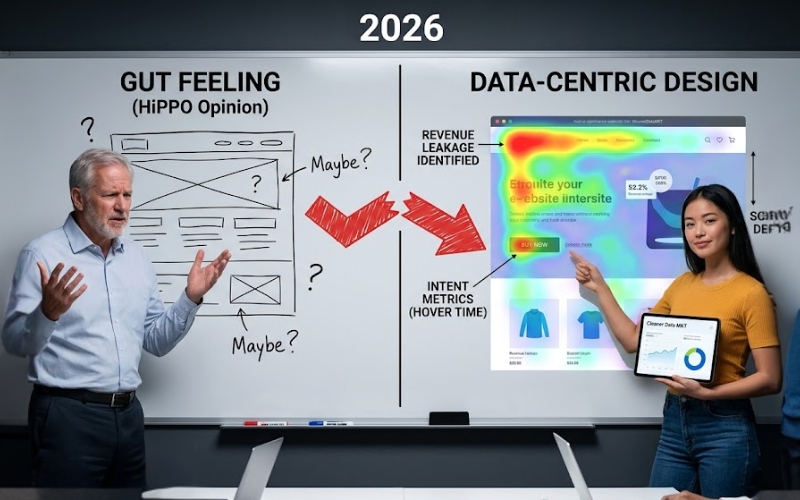
Today’s users are sophisticated. They interact with hundreds of interfaces daily and have developed an intuitive “sixth sense” for friction. If your checkout process takes two seconds too long or your navigation menu is cluttered, they won’t complain—they will simply leave. The cost of poor design is no longer just “lost likes”; it is measurable revenue leakage.
Moving Beyond Gut Feeling
Historically, design decisions were often made by the “Highest Paid Person’s Opinion” (HiPPO). In 2026, this approach is a liability. Data-centric design replaces guesswork with empirical evidence. By integrating Marketing Data Cleaning and Analytics, we can distinguish between “vanity metrics” (like page views) and “intent metrics” (like hover time over a CTA or scroll depth on a product page).
Data allows us to see the invisible struggles of a user. For instance, a user repeatedly clicking a non-clickable icon (rage clicking) isn’t a user error—it’s a design failure that data can identify and rectify before it impacts your bottom line.
Psychological Laws of Data-Driven Design

Psychological Laws of Data-Driven Design
To create high-converting interfaces, we must look at the intersection of data and human psychology. In 2026, we apply classic UX laws backed by modern behavioral data to ensure optimal performance.
Fitts’s Law: Predicting Motion and Target Accuracy
Fitts’s Law states that the time to acquire a target is a function of the distance to and size of the target. In a data-centric world, we don’t just guess button sizes. We analyze click-accuracy data across different mobile devices to determine the “Sweet Spot” for your Call to Action (CTA). If your “Buy Now” button is too small or placed in a high-friction area of the thumb zone, your conversion rates will suffer. We use engagement data to optimize button placement, ensuring that the most important actions are the easiest to perform.
Hick’s Law: Overcoming the Paradox of Choice
Hick’s Law posits that the time it takes to make a decision increases with the number and complexity of choices. Modern data consistently shows that “less is more.” When we analyze user drop-off points in complex navigation menus, we often find that narrowing the options leads to a 20-30% increase in conversion. Data-Centric UI/UX involves using analytics to prune away the features your users don’t actually use, leaving a streamlined path to purchase.
The Core Pillars of a Data-Driven Design Strategy
Implementing a successful UI/UX strategy in 2026 requires a multi-layered approach that connects technical performance with user psychology.
1. Quantitative Behavioral Tracking
We utilize tools like GA4, Mixpanel, and Hotjar to gather hard numbers. We look for patterns in the “User Flow”—where do they enter, where do they linger, and where do they exit? If a significant portion of your traffic drops off at the “Shipping Information” page, the data is telling us that your UI is either too complex or lacks trust signals at that critical juncture.
2. Qualitative User Insights
Data isn’t just numbers; it’s the “Why” behind the “What.” Through session recordings and AI-driven sentiment analysis of user feedback, we gain a qualitative understanding of the user’s emotional state. This is where Strategic Data-Driven SEO Services become vital. By understanding the search intent that brought the user to your site, we can align the UI to meet their specific expectations, creating a seamless transition from the search result to the landing page experience.
3. Continuous A/B and Multivariate Testing
In 2026, a static design is a dying design. We employ continuous A/B testing to validate every design choice. Does a blue button outperform a green one? Does a “Free Trial” CTA convert better than “Get Started”? We let the users decide through their actions. This iterative process ensures that your design is constantly evolving toward its most efficient form.
Predictive UX: The New Frontier of Personalization
As we move deeper into 2026, the industry is shifting from reactive design to predictive design. Predictive UX uses machine learning to anticipate what a user might need next and dynamically adjusts the interface to provide it.
Imagine an interface that realizes a user is struggling to find a specific feature and automatically highlights a “Help” tooltip. Or an e-commerce site that reorganizes its homepage layout in real-time based on the visitor’s past browsing data. This level of hyper-personalization reduces cognitive load and fosters a sense of “brand intimacy” that traditional, one-size-fits-all designs can never achieve.
Case Study Scenarios: Data in Action
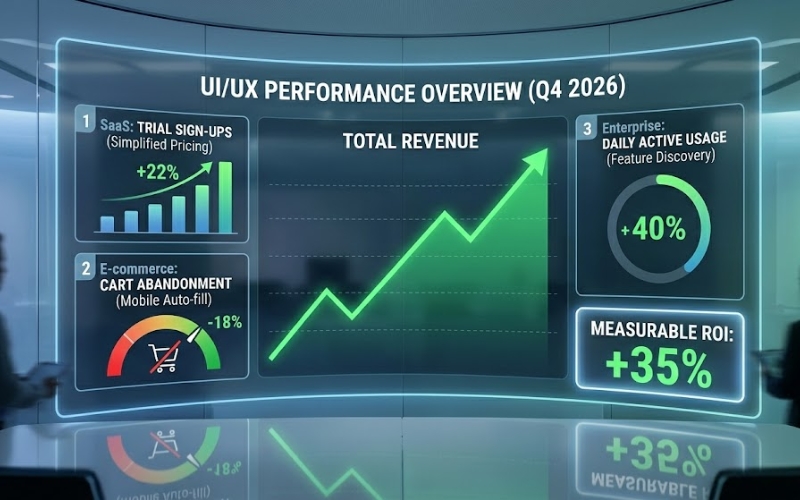
| Industry Context | Data Observation (The Problem) | UI/UX Intervention (The Solution) | Impact on Conversion |
|---|---|---|---|
| SaaS Platform | High bounce rate on the pricing page (75%+). | Simplified pricing tiers and added a “Most Popular” highlight. | 22% increase in trial sign-ups. |
| E-commerce | Mobile users abandoning carts during the address entry phase. | Implemented auto-fill address API and minimized form fields. | 18% reduction in mobile cart abandonment. |
| Enterprise App | Low feature adoption for a new analytics dashboard. | Used data to identify the most used metrics and moved them to the top-left. | 40% increase in daily active usage. |
Technical Synergy: Design and Development
A beautiful design is worthless if it doesn’t load. In 2026, Google’s Core Web Vitals are more stringent than ever. Technical SEO and UI/UX are two sides of the same coin. This is especially true in Custom Mobile App Development, where every byte of data transferred must be optimized for speed and efficiency.
Data-centric design includes optimizing assets—ensuring that images are served in next-gen formats and that CSS/JavaScript doesn’t block the “Main Thread.” When the UI is lightweight and the UX is intuitive, search engines reward you with higher rankings, and users reward you with their loyalty.
Ethical Design and Data Privacy in 2026
With great data comes great responsibility. In the post-GDPR/CCPA world, users are highly conscious of their privacy. Data-Centric UI/UX design must be Ethical Design. This means:
- Transparency: Clearly communicating how user data is being used to improve their experience.
- Zero-Party Data Strategy: Asking users for their preferences directly rather than relying solely on covert tracking.
- Accessibility: Ensuring that data-driven optimizations don’t exclude users with disabilities. Accessibility is no longer just a “nice to have”; it is a legal and moral requirement that also happens to improve SEO.
ROI: The Business Value of Data-Driven UX
ROI: The Business Value of Data-Driven UX
For the C-suite, the most important “Data” in UI/UX is the Return on Investment (ROI). Investing in a data-centric redesign isn’t a cost—it’s a capital investment with measurable returns. By reducing Customer Acquisition Costs (CAC) and increasing the conversion rate, you create a more efficient revenue machine.
Furthermore, good UX reduces the strain on customer support. When an interface is intuitive, users don’t need to call a support line or open a ticket. This “hidden ROI” of UI/UX is often what separates market leaders from laggards in the enterprise sector.
Conclusion: Designing Your Future with Precision
The era of designing by committee or by trend is over. In 2026, the only opinion that matters is the one backed by data. A Data-Centric UI/UX strategy allows your brand to move with confidence, knowing that every change you make is moving you closer to your customers and your business goals.
At Cleaner Data MKT, we specialize in bridging the gap between raw data and human-centric design. Whether you are launching a new product or optimizing an existing enterprise platform, our team of experts is ready to help you unlock the power of your data.
Are you ready to stop guessing and start growing? Contact us today for a comprehensive UI/UX and data audit, and let’s build an interface that truly performs.