


Rank Higher with Strategic Data-Driven SEO Services 2026
In the digital landscape of 2026, the traditional SEO playbook—relying on keyword density and backlink volume—is not just outdated; it is fundamentally broken. We have entered the age of Predictive Search and Search Generative Experience (SGE). Search engines are no longer just indexing pages; they are understanding intent, context, and the complex relationships between entities. At Cleaner Data MKT, we treat SEO as a high-stakes data science, where visibility is earned through precision, technical excellence, and deep semantic authority.
Strategic SEO in 2026 requires a move away from “SEO as a tactic” to “SEO as a core data asset.” To rank today, your brand must transition into a trusted authority that provides Information Gain—unique value that AI models can identify, cite, and recommend to users. This guide explores our proprietary framework for dominating search through data-driven intelligence and high-fidelity technical optimization.
The Fundamental Evolution: From Keyword Strings to Knowledge Entities
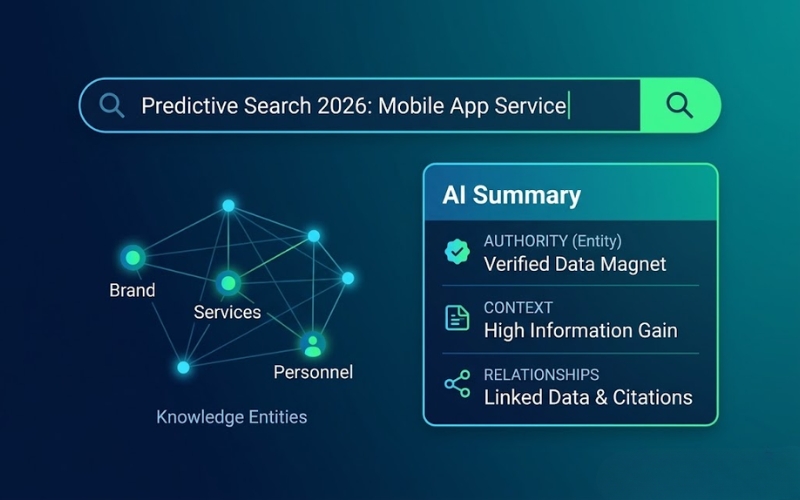
The core shift in 2026 is the transition from “strings” to “things.” Google and other AI-driven search engines now utilize advanced vector embeddings and Knowledge Graphs to understand the digital world. They no longer look for the exact phrase “best mobile app service”; they look for the Entity that possesses the most authority, verified data, and positive user feedback in that specific domain.
The Anatomy of Entity-Based SEO
An entity is a well-defined concept or object. In the eyes of an AI crawler, your brand is an entity, your services are entities, and even your key personnel are entities. Entity-based SEO involves building a web of connections that confirm your brand’s place within its industry. This is achieved through sophisticated Linked Data strategies, ensuring that every piece of content you publish reinforces your brand’s expertise. By focusing on entities, you create a search presence that is resilient to the minor algorithmic fluctuations that often cripple keyword-focused websites.
The Rise of Search Generative Experience (SGE) and AEO
SGE has transformed the Search Engine Results Page (SERP) into an “Answer Engine.” In many cases, the user never even clicks through to a website because the AI provides the answer directly in a summarized snapshot. To thrive in this environment, your strategy must pivot toward Answer Engine Optimization (AEO). This involves structuring your data in a way that AI models (like Gemini or GPT-based search) can easily ingest and cite.
To be cited as a primary source, your content must satisfy three criteria:
- Accuracy: Verified through cross-referencing with trusted data sources.
- Structure: Utilizing the latest Schema.org markups to define data points.
- Uniqueness: Providing insights that cannot be found elsewhere.
The Concept of Information Gain: Why Uniqueness is the New Ranking Factor
The Concept of Information Gain: Why Uniqueness is the New Ranking Factor
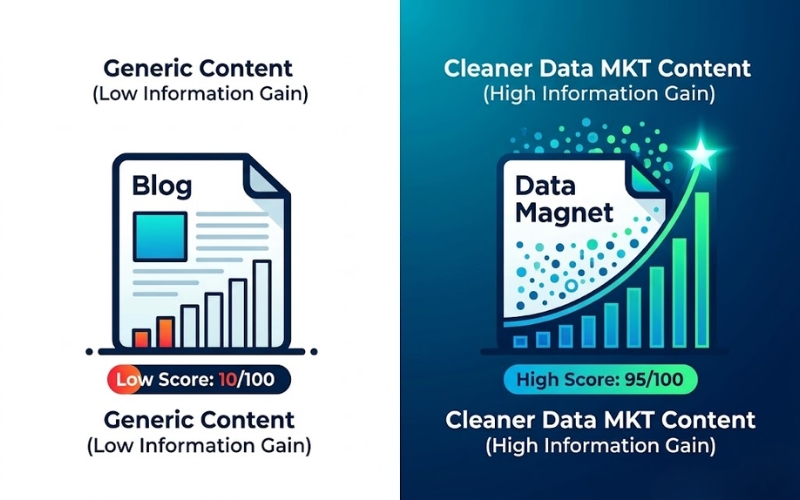
Search engines in 2026 actively penalize “copycat content.” If your article simply paraphrases existing top-ranking results, its Information Gain Score will be low, leading to poor visibility. Information Gain is the measure of new, unique information an article provides compared to what the search engine already knows. This is why Marketing Data Cleaning and Analytics is so critical to modern SEO—it provides the raw, unique insights and internal benchmarks that AI models love to cite as original research.
When you publish proprietary data, you aren’t just writing a blog post; you are creating a “Data Magnet.” Other websites link to you as the source, and search engines recognize you as the originator of the information, granting you a massive boost in authority that generic content can never achieve.
Our Proprietary Data-Driven SEO Framework
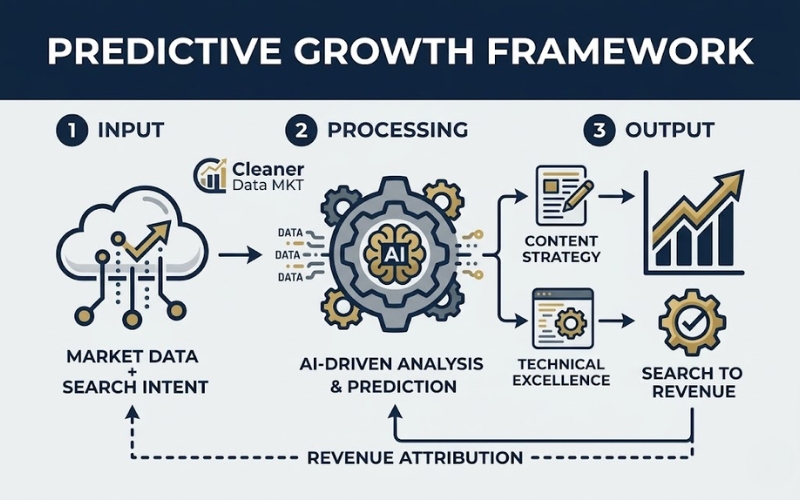
We have replaced the generic SEO audit with a Predictive Growth Audit. Our framework is designed to align your technical infrastructure with the evolving psychology of the 2026 searcher and the requirements of neural-network-based search algorithms.
Phase 1: Predictive Market Analysis & Search Intent Mapping
Instead of looking at what people searched for yesterday, we use AI-driven models to predict what they will search for tomorrow. By analyzing market shifts, social signals, and consumer behavior data, we map out a content strategy that intercepts users at every stage of their journey. We categorize intent with granular detail:
- Informational Intent: Seeking deep understanding or solutions to complex problems.
- Commercial Investigation: Comparing specific high-ticket solutions and looking for data-backed proof.
- Transactional Intent: Highly specific queries ready for immediate conversion.
By aligning these intents with a Data-Centric UI/UX Design, we ensure that once a user lands on your site, the interface facilitates their specific intent without friction, turning organic traffic into measurable revenue.
Phase 2: Technical Precision & Core Web Vitals 2026
Technical SEO in 2026 is no longer about simple meta tags. It is about Performance-First Engineering. Google now monitors Interaction to Next Paint (INP) as a primary ranking factor. This metric measures the time it takes for a page to respond to a user’s first interaction—like a button click or a menu toggle.
If your site has high latency, your rankings will plummet, regardless of content quality. This level of technical excellence is especially vital for businesses investing in Custom Mobile App Development. In 2026, the synergy between web visibility and app engagement is a key ranking factor; your web presence must act as a seamless gateway to your mobile experience.
Phase 3: Semantic Content Clustering & Topical Authority
Individual pages no longer rank in isolation. To dominate a niche, you must build Topical Authority through Semantic Content Clustering. We identify a “Pillar” topic and build an expansive “Topic Cluster” around it—answering every secondary and tertiary question a user might have. This signals to the search engine that you are a complete subject matter expert.
By utilizing AI Marketing Content Solutions, we can scale this clustering process while maintaining the high E-E-A-T (Experience, Expertise, Authoritativeness, Trustworthiness) standards. Every piece of content is verified by human subject matter experts to ensure it provides real-world value that a machine alone cannot produce.
The Synergy: SEO as Part of the MarTech Ecosystem
The Synergy: SEO as Part of the MarTech Ecosystem
In the enterprise world of 2026, SEO is no longer a siloed department. It is deeply integrated with development, UX, and data science. When these departments work together, you create a digital ecosystem that is virtually impossible for competitors to displace.
| SEO Factor | Traditional Approach (Pre-2026) | Data-Driven Strategy (2026) |
|---|---|---|
| Keyword Targeting | Individual high-volume keywords. | Semantic entities and intent clusters. |
| Content Creation | Writing for the “Search Engine.” | Creating high Information Gain for “AI Recommendation.” |
| Technical SEO | Basic site speed and sitemaps. | Interaction to Next Paint (INP) and API-first indexing. |
| Backlinks | Quantity-focused guest posting. | Quality-focused “Entity Citations” and Data Mentions. |
| Goal Tracking | Focus on “Rankings.” | Focus on “Revenue Attribution” and LTV. |
E-E-A-T and “Human-in-the-Loop” Verification
As the web becomes flooded with generic AI-generated “noise,” search engines are doubling down on E-E-A-T. They are looking for signs of real-world experience that a bot cannot simulate. Our data-driven SEO strategy focuses on building these signals through:
- Author Verification: Ensuring your content is linked to verified profiles with a history of expertise.
- First-Party Data Integration: Using your own internal analytics and case studies to back every claim.
- Brand Authority: Building a footprint of mentions across high-authority, trusted digital publications.
Trust is the hardest currency to earn in 2026. By ensuring your data is clean and your insights are original, you build a level of trust with both the user and the search algorithm that becomes your greatest competitive advantage.
Measuring Success: Beyond Clicks to Revenue Attribution
The most dangerous trap in SEO is focusing on “Vanity Metrics” like impressions or total clicks. In 2026, a click is only valuable if it leads to a measurable business outcome. We use advanced attribution models to track the entire SEO journey, from the first touchpoint to the final conversion.
We analyze:
- Assisted Conversions: How many times did your SEO content help a user make a decision, even if they didn’t convert on that specific visit?
- Content ROI: Which specific topic clusters are driving the highest Lifetime Value (LTV)?
- Search-to-Sales Velocity: How quickly does an organic visitor move through your sales funnel?
By connecting your organic search data with your CRM, we can show you the exact return on your investment, allowing you to treat SEO as a predictable and scalable revenue channel.
SEO in 2026 is a discipline of precision. It is no longer enough to be “online”; you must be the most trusted, most data-backed, and most semantically relevant entity in your field. Strategic Data-Driven SEO Services provide the competitive edge needed to outpace algorithm updates and capture the attention of an increasingly AI-reliant audience.
At Cleaner Data MKT, we have the analytical tools and the strategic vision to turn your search presence into a dominant market force. Stop fighting for keywords and start owning your niche through the power of data intelligence.
Ready to lead the search results of 2026? Contact our strategic SEO experts today for a comprehensive Predictive Growth Audit and unlock your true digital potential.